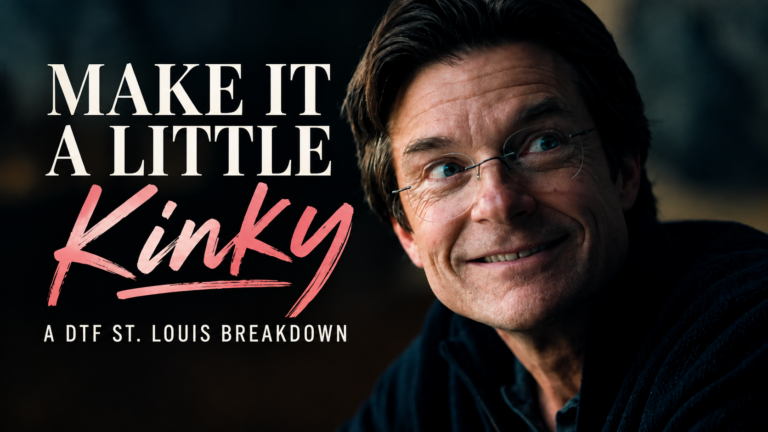
DTF St. Louis: What Your TV Pilot Needs To Do Pt 1
September 25, 2026
No Comments
What does your TV pilot need for your series to succeed and how do you make sure you’re fulfilling those needs from page one?


On this podcast, rather than reviewing movies and TV shows “two thumbs up, two thumbs down” Award Winning Screenwriter Jacob Krueger shows you what you can learn from them as a screenwriter.
This podcast is offered absolutely free and with no outside advertising, so if you like what you hear, please subscribe on Apple Podcasts and write us a review.
Popular Episodes
SUBSCRIBE


All Podcasts
Podcast: Play in new window | Download
Subscribe: RSS
What are intrusive thoughts—and what are you supposed to do with them as a writer?In this episode of the podcast, Jacob Krueger explores intrusive thoughts not as a psychological obstacle, but as a powerful creative tool. Because the real challenge of writing isn’t eliminating distraction—it’s learning how to transform what interrupts you into inspiration. Drawing on the film and play versions of Amadeus, Jake shows how Peter Shaffer externalized his own competing inner voices into two unforgettable characters: Salieri, the embodiment of self-doubt, and Mozart, the expression of divine creative impulse. The result is not just great drama—but a blueprint for turning internal conflict into structure, character, and change.
https://youtu.be/nCZsippa14o
Podcast: Play in new window | Download
Subscribe: RSS
How do you make a devastating story feel funny—without losing its truth?In this episode of the podcast, Jacob Krueger explores Dying for Sex, the extraordinary limited series created by Elizabeth Meriwether and Kim Rosenstock, to break down one of the most elusive tools in screenwriting: tone.Focusing on a single scene from episode 5, Jake shows how the writers take one of the darkest confrontations imaginable—a daughter facing her mother about trauma—and shape it into something that is simultaneously heartbreaking and hilarious.Along the way, he explores three key ideas: how juxtaposing tones can deepen emotional impact, why tone is something you layer over your script in rewrites, and how tone is central to a television series engine—helping a show feel both the same and different across episodes.Drawing inspiration from Falstaff’s tragicomic end in Henry IV, Part 2, Tony Soprano’s fractured family, and his own early playwriting misadventures, Jake reveals a powerful truth:Tone isn’t a single instrument you play.It’s something you shape—note by note—until the whole piece sings.
https://youtu.be/CbVGuKWJoDk
Podcast: Play in new window | Download
Subscribe: RSS
What is a TV Bible today, and why do you need one to sell your show?In this episode of the podcast, Jacob Krueger breaks down the TV Bible not as an industry insider’s document, but as a practical creative tool for proving that your show actually works. Because the real challenge of television isn’t writing a great pilot. It’s building an engine that can generate story—episode after episode—without losing the spark that made the show exciting in the first place. aJake explores how TV writing has evolved from the days of syndication to the streaming era, why even strong pilots fail without a clear engine, and what producers, agents, and executives are really looking for when they read your Bible. Along the way, he shows how series like Breaking Bad, Homeland, The Bear, and Seinfeld succeed by delivering a specific feeling that works again and again.If you’ve ever wondered why some shows run for years while others fall apart after a few episodes, this episode offers a clear and practical framework for building an engine that lasts.
https://youtu.be/H0BBYXmQIQY
Podcast: Play in new window | Download
Subscribe: RSS
What happens when you take the structure of a movie you love—and try to breathe new life into it?
In this episode of the podcast, Jacob Krueger explores In the Blink of an Eye, the ambitious sci-fi drama written by Colby Day that premiered at Sundance and is now streaming on Hulu. Deeply influenced by Darren Aronofsky’s The Fountain, the film unfolds across three timelines connected by shared questions about death, evolution, and the fragile miracle of human life.
Comparing the two films as a case study, Jake explores three deceptively simple craft lessons: how writers can repurpose the structure of the movies that inspire them toward new ends; why theme only lands when the writer is genuinely wrestling with it; and what you can learn about good dialogue from a family of grunting neanderthals.
Along the way, he shows how even strong films with beautiful performances can lose their emotional punch the moment a writer stops trusting the audience.
https://youtu.be/ZDGocOgSFG8
Podcast: Play in new window | Download
Subscribe: RSS
Why do we stay emotionally locked into a story even when the plot sounds flat on paper—or morally repellent in practice? In this episode, Jacob Krueger breaks down Park Chan-wook’s darkly hilarious, deeply unsettling No Other Choice to reveal the engine that makes it so powerful: not plot, but structure. Using the film’s escalating moral pressure as a case study, Jake shows how structure is built from choices—how characters deal with what happens—and how theme emerges when you drive a protagonist to the moment where they truly feel they have no other choice.
https://www.youtube.com/watch?v=2vAyXWPxijQ
Podcast: Play in new window | Download
Subscribe: RSS
What does it actually mean to adapt a story- and how can radically different adaptations emerge from the same source material? In this episode, Jacob Krueger looks at the novel and film versions of Hamnet and the ’90s award darling Shakespeare in Love to show how finding the location of your adaptation shapes character, structure, tone, and theme—and why successful adaptations are defined less by fidelity to source material than by the clarity of your intentions
https://youtu.be/kydrSMmbJsg
This is by far the most insightful and consistently rich-with-advice podcast I’ve found. Krueger has such a surgically clear understanding of what makes a story work on the screen that he’s able to crystallize the problems or successes of a film/show in the most helpful and practical ways.
I listen primarily to film-related podcasts and this is far and away the best one dedicated to the art and craft of screenwriting. Many times I found my options for insight limited to either outdated or just plain nonsensical “rules” of screenwriting gurus or non-specific if not jaded advice from even some of my favorite working writers. This podcast provides honest and nuanced lessons that can be applied to every aspect of the writing process. I can not recommend it highly enough.
Whenever I get stuck, I listen to an episode and I can write again! Thanks to Jacob, I've finished three short screenplays in three months. That's a big leap for me. He offers a lot of amazing techniques and concepts that I've never thought of before but are absolutely useful. Thank you!
Listening to Jacob is like taking a masterclass in screenwriting and having your head cleared in a therapy session at the same time… Next level, consciousness-raising stuff.
For three decades, I've aspired to write screenplays. However, as a single mother and the owner of an agency that books professional speakers, celebrities, and notable presenters (I'm an expert in the industry), along with one challenge after another, life kept getting in the way. Still, I immersed myself in the craft whenever I could. I own practically every book ever written on screenwriting and had a couple of screenplays in the works. Finally, I was able to get serious. In doing so, I recently discovered screenwriting podcasts. Without a doubt, Jacob Krueger's "Write Your Screenplay" podcast is my absolute favorite. Within the last month, I've listened to every single episode. I truly appreciate Jacob's unwavering wisdom, his uncanny ability to dig deep into the psychology of a film, the spiritual way he looks at things, and his infectious voice.
As a wanna-be screenwriter, I find the way the films are broken down in these podcasts gives me great insight for my own writing.
Jacob Krueger is very insightful and truly knows how to break down a film, whether it was good or not and helps you understand the elements that either make or break your script. I also have to say that after listening to his podcasts more and more, I have felt the urge to write more, no matter how bad my writing might be at the beginning. I know the more I write, the closer I’ll get to my best material as well as where I need to go.
I absolutely love this podcast and look forward to every episode. Jacob breaks down films and explains why they worked or why they didn’t work like no other. Each podcast inspires me to keep writing. Even if you are not a writer, this podcast will help you enjoy films more.
I have been listening to Jacob's podcast for a couple years now and finally started taking his classes. I have learned so much and have become a better writer picking his brain. They work with you every step of the way, I would highly recommend this class for anyone who wants to take their writing further.
I'm so grateful to have found Jake and the wonderful community he has built. I recently took his Write Your Screenplay class where he teaches the fundamentals in a highly entertaining way. I'm now enrolled in a Workshop so get the best of both worlds - personal instruction and peer mentors for encouragement. I also highly recommend listening to Jacob's podcast, Write Your Screenplay. It's hours of free, really high quality instruction.
I have been listening to Jacob's podcast for a couple years now and finally started taking his classes. I have learned so much and have become a better writer picking his brain. They work with you every step of the way, I would highly recommend this class for anyone who wants to take their writing further.
I don't have words for how incredibly special this studio is. As a baby writer I was so nervous, and everyone has been nothing short of wonderful and encouraging. I found Jacob through his podcast (which I also HIGHLY recommend) and I have learned so much in the short amount of time I have been in class. Not only the vast knowledge, but Jacob and everyone he has hired care so much about writers and artists and helping you in the way you need along your journey. Part professor, part mentor, part cheerleader...every artist needs a studio like this in their life!
Jacob is giving away gold.